The (New) RePublic Cafe
(New) Republic Cafe
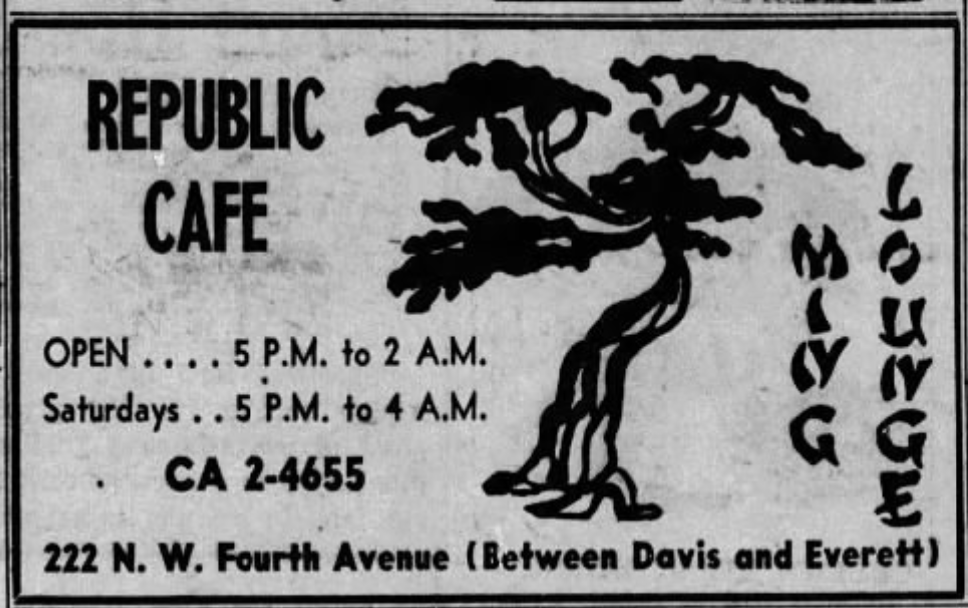
September 30, 1955 advertisement for the Republic Cafe and Ming Lounge, providing the adress, phone number, hours opened and showing a tree, possibly a Chinese Scholar tree?
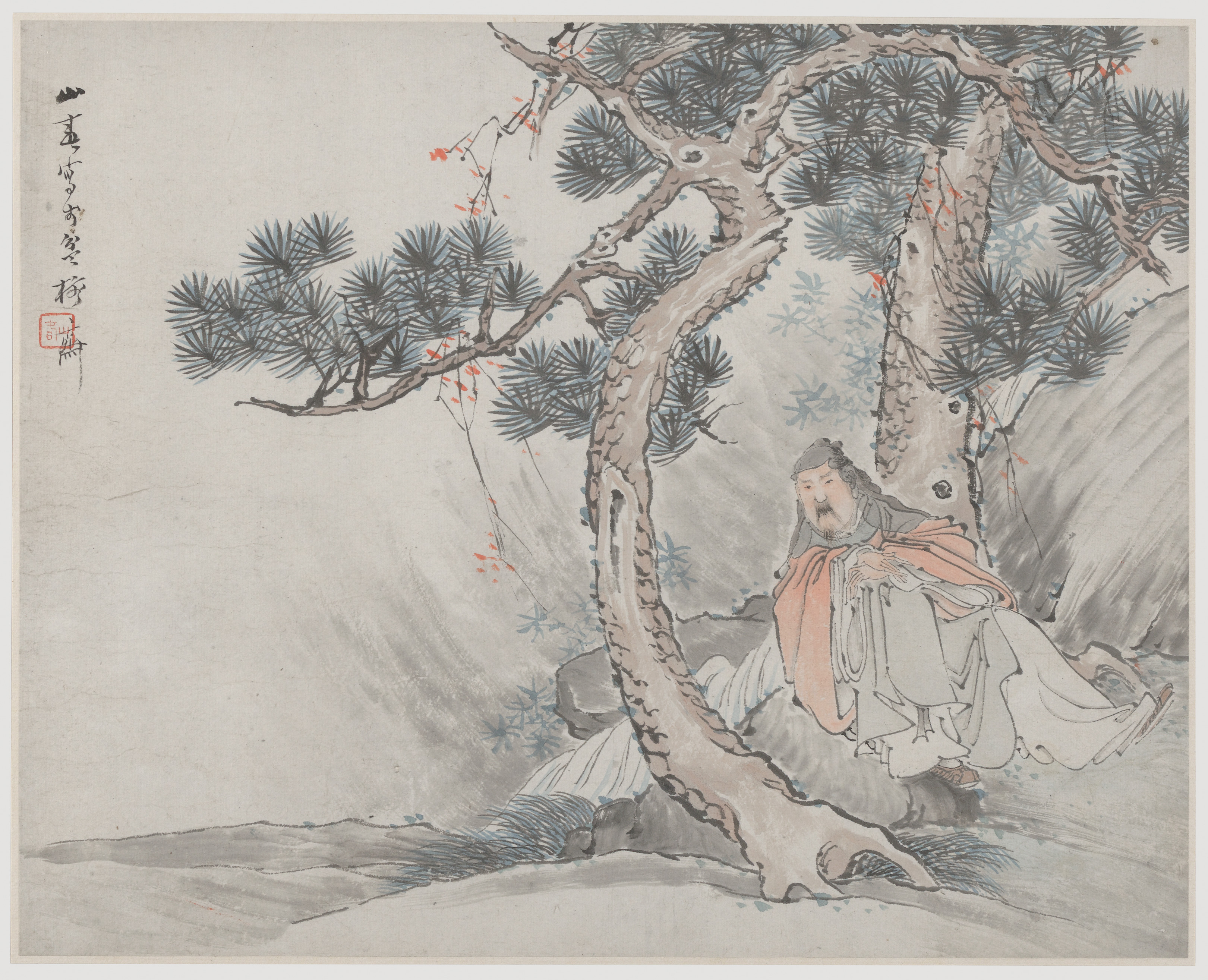
Image of a scholar tree in a Qing Dynasty era painting, the tree looks very similar to the image used by the republic in its advertising, and evokes the roots of the democratic Chinese Republic in the values of modernity and appreciation of arts and culture.
On January 9, 1912, the Oregonian reported on massive celebrations taking place among the Chinese American population of Portland. Sponsored by the Young China Association, a youth movement that supported the Democratic Republic and advocated for cultural patriotism for China and its diaspora, the streets of Chinatown were filled with celebrants honoring the overthrow of the Manchu government and the inauguration of Sun Yat Sen. The newspaper commented on how different the processions that marked the celebrations looked from other Chinese festivals in the city, with men in western suits, Chinese and US flags waving everywhere, and men and women marching in the new white uniforms of the new Chinese army (women marched as representatives of the nursing units). At least 100 merchants were described following the military procession in their cars. Indeed, celebrations for the “New Republic”, in Portland and elsewhere across the US were notable to those outside of the community.
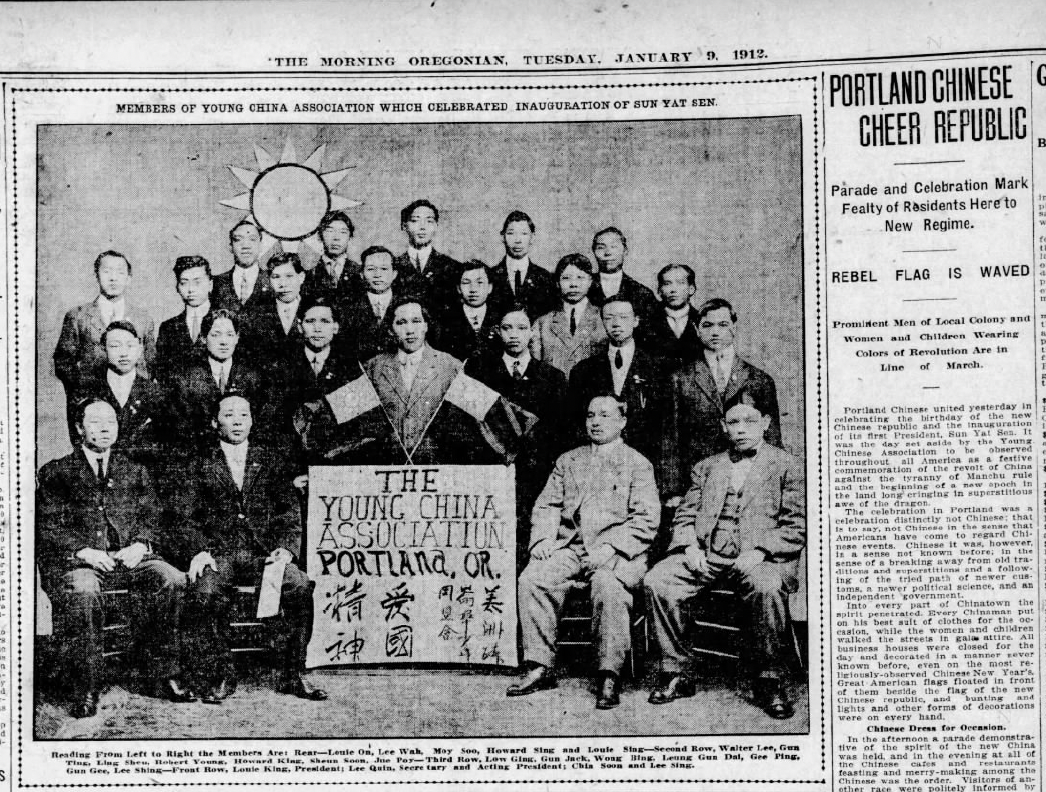
January 9, 1912, front page of Portland Oregonian showing a gathering of young Chinese American men sitting in front of a sign reading “The Young China Association Portland, OR in English, and Chines characters below. A pair of small flags are mounted from the top of the sign, both being flags of the new Republic.
One way the governmental change was marked was in the names of Chinese restaurants, with “New Republic", “Young China”, “Modern China”, “New China” being forms that show up honoring the governmental change. And Portland was no different. Opened originally as the “New Republic”, Sam P. Soohoo’s restaurant clearly communicated pride in the transformations in China. General wisdom was that Soohoo, a native of Canton who came to the US in 1915, opened the restaurant shortly after he arrived in Portland, in 1928. The Register of Historic Places nomination form for the building puts the opening date at 1930. So far, I haven’t found any records referring to the restaurant that early. The restaurant was located at 222 N.W. 4th Street, in the boundaries of what is known as Portland’s first China town, though as Mary Rose Wong notes in her book, Sweet Cakes, Long Journey, the history of Chinese American settlement in Portland is considerably more complicated.
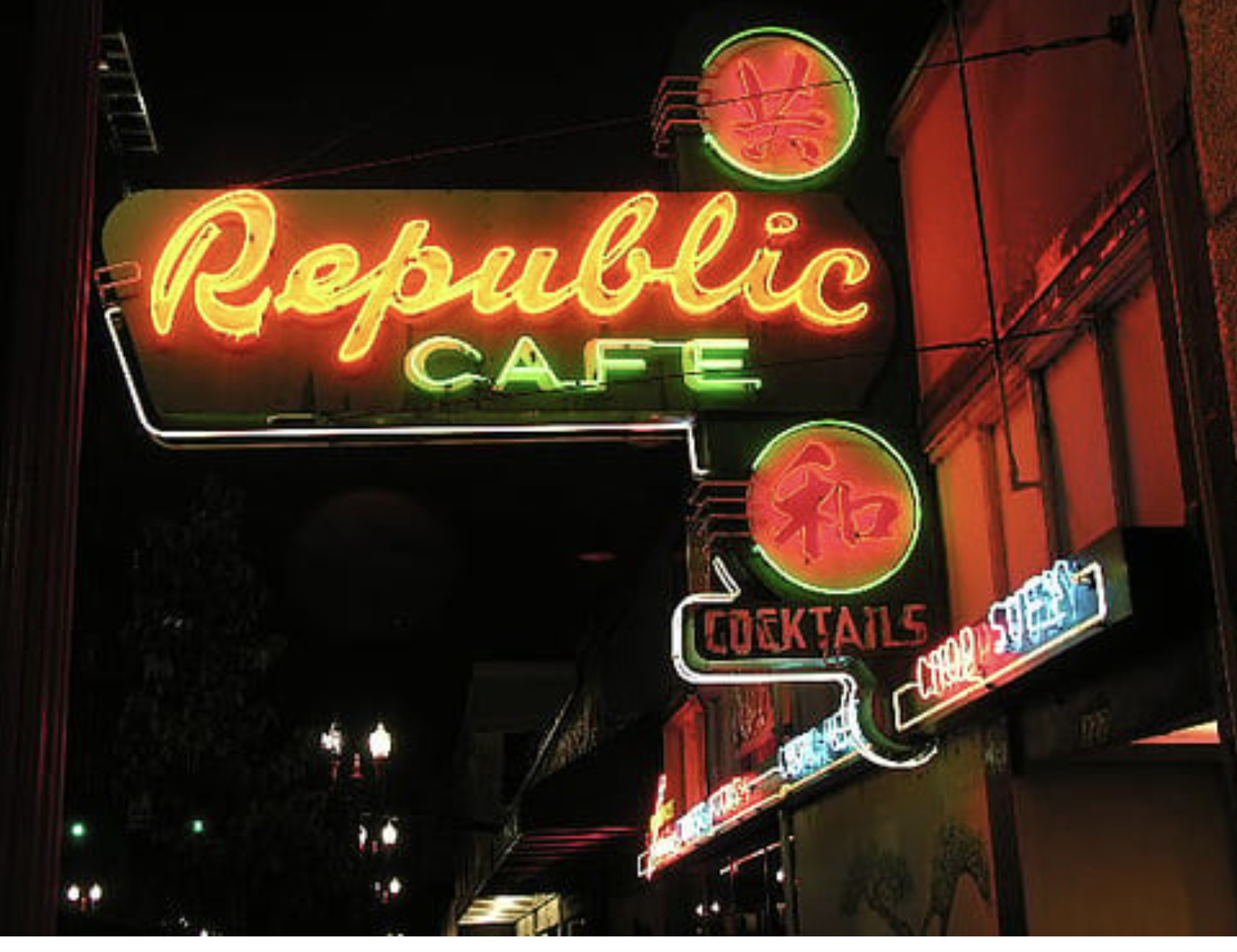
The famous neon sign of the Republic Cafe at 222 NW 4th Ave, Portland’s Old Chinatown.
Writers to the Oregonian in 1963, recalled the “New Republic” being a hole in-the-wall restaurant. Why the name change? It was probably related to re-branding rather than any change of feelings about China’s democratic experiment. Re-branding was driven by a horrific event at the restaurant–the 1942 murder of cook Wong Hai by cleaver-wielding Lok Poy. If the murder wasn’t horrific, the use of a cleaver gave the killing an air that resonated with the worst biases of the non-Chinese American community. Newspapers covered the murder breathlessly a second time when a week later, Poy died by suicide in jail, leaving a note written in Chinese for his friends. Perhaps given this negative publicity, it is no surprise that the New Republic ceased to be, and instead the Republic, at the same address and still under Soohoo’s ownership, appeared in the 1943 City directory–the first time I was able to find a listing for the restaurant under either name.
In its new incarnation, the Republic applied for a liquor license, being approved in 1953, with the space then advertised as “Republic Cafe and Ming Lounge”. Around this time, Victor Wong, who had begun to work at the restaurant as a busboy, became co-owner. Together, the pair continued to own the restaurant until 1979.
The restaurant drew attention again in local papers in 1958, when neighbor, Wayne Fong, who ran “Fong’s Curio Shop” next to the Republic, was arrested for selling “smoking opium” and “heroin”. Adding an exciting wrinkle to the reporting, Fong’s associate, Jung Jim, was caught selling heroin to an undercover federal agent at the Republic. Newspapers insisted on referring to the restaurant by its old name, New Republic. Wayne Fong and his wife Sherry, a wife woman, were already infamous in Portland for their association with the death of Diane Hank. A sixteen year old babysitter for the Fongs, Diane disappeared after reportedly partying with the Fongs, and was later found dead in a ditch, her body in a state of undress. The Fongs drew attention immediately for the crime of being an interracial couple. Both Fongs were convicted to death for the murder of Diane Hank, but their verdicts were set aside by a judge who found no compelling evidence. Whatever his role in Diane Hank’s death, Fong was proven to be one of the biggest drug suppliers on the west coast and served 20 years for associated crimes.
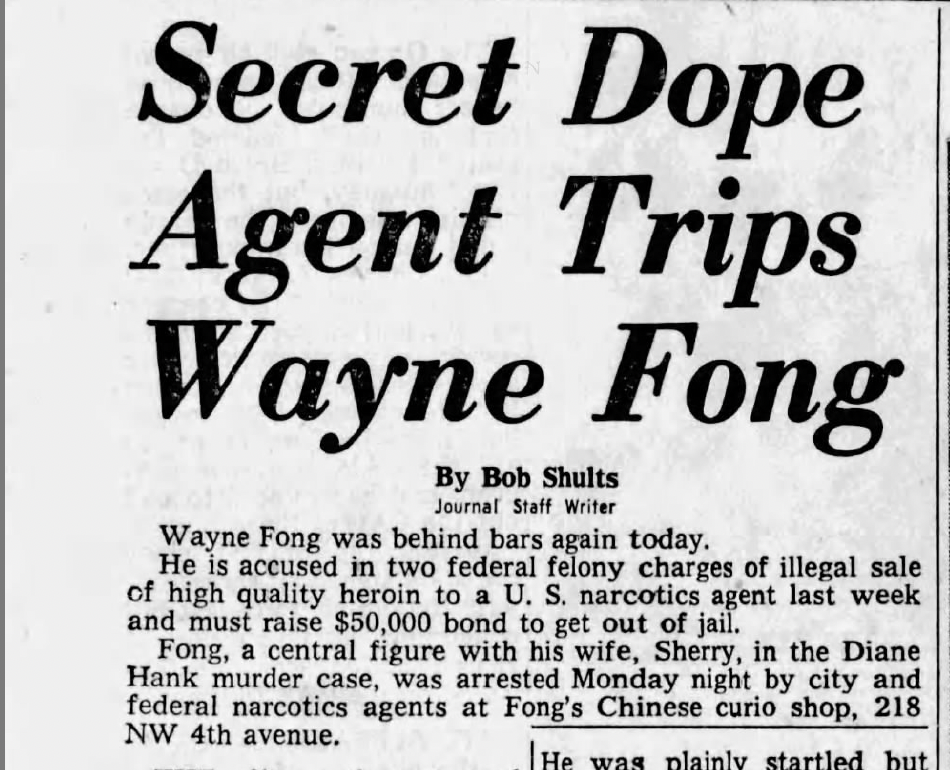
Notable persons like Wayne Fong, who drew attention away from the thousands of hard-working, law-abiding residents of Chinatown, actually drew gawkers to Chinatown. As had been the case historically, these ethnic enclaves were represented as places where crimes of sexual trafficking (especially white slavery), drug use, gambling and other vice crimes thrived. This air of danger contributed to the popularity of going to Chinatown to dine, drink, dance and listen to music among younger people.
The Republic Cafe, perhaps benefitting from this notoriety, became incredibly popular in the 1950s and 60s, drawing big name stars like Louis Armstrong, Harry Belafonte and Ella Fitzgerald, and Danny Kaye to dine there. Is it a coincidence that these stars were all non-white? As we saw with the Lotus Room in St Louis, or later on with punk musicians in Los Angeles’ Chinatown, Chinese Restaurants were spaces that could be welcoming to diverse audiences, providing safe spaces otherwise unavailable. Interviews with long-term staff that appeared in local papers recalled not only the celebrities who visited the restaurant, but also the importance of the space for Portland’s Jewish families seeking take-out or dining in meals on Sundays. While the heydey of the restaurant was in the 1950s and 1960s, it continued to draw a loyal following during the 1970s. With the relocation of Chinatown from downtown to 82nd Street, fewer customers came to the restaurant. The restaurant, billed as “Portland’s Oldest Restaurant”, has continued to remain open, despite continued changes in ownership. The fortunes of the restaurant are tightly linked to attempts to revitalize Portland’s first Chinatown.
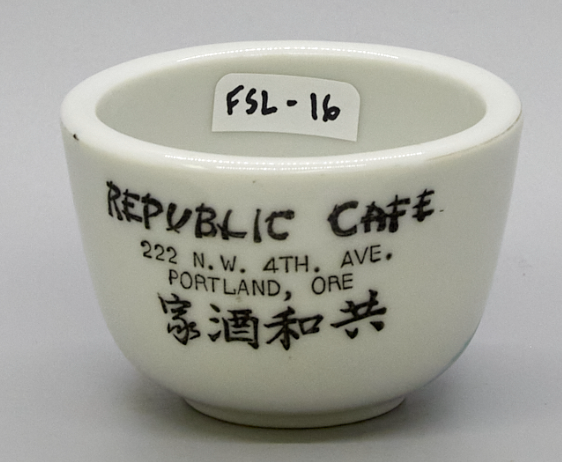
Image showing a FS Louie teacup for Republic Cafe, the cafe’s name appears in a “Chop Suey” font, whereas the address is in a san serif font.
It seems likely that FS Louie was able to sell ceramics to the Republic early in his business. The cup only says Republic, with Chinese characters below the name stating “Home Wine Sharing”. The cup bears the Wen mark that Louie seems to have used early in his business. The Republic is one of the businesses that appear in photographic montages of Louie ceramics in the company’s 1960 catalog, demonstrating that Soohoo and Wong were Louie customers by 1960 at the latest. (For those archaeologists keeping score at home, this would be a rare TAQ…Terminus Ante Quem…to have had bespoke wares appear in the catalog, the bespoke wares had to have been manufactured before the creation of the catalog in 1960!)
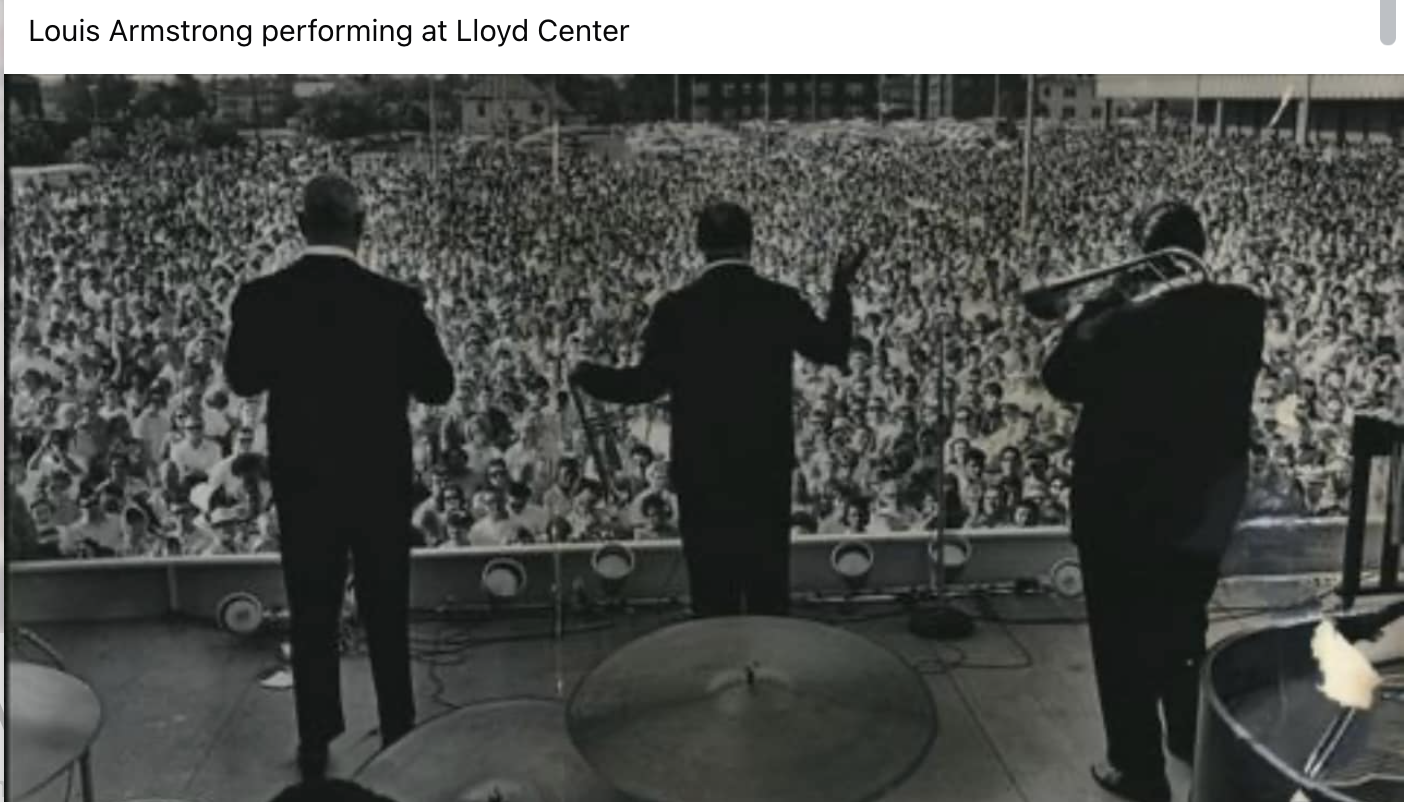
Undated photo, Louie Armstrong performing in Portland. https://www.facebook.com/groups/296569815544787/posts/950008653534230/
Let’s just pause for a moment and consider the implications of that–Louie Armstrong, Ella Fitzgerald, Danny Kaye or Harry Belafonte may have once sipped tea from this FS Louie cup!
References cited:
National Record of Historic Places Nomination, Portland Chinatown District.
https://web.archive.org/web/20201210234910/https://www.nps.gov/nr/feature/asia/2013/OR_89001957.pdf
https://www.metmuseum.org/art/collection/search/737765
Wong, Marie Rose. Sweet Cakes, Long Journey : The Chinatowns of Portland, Oregon / Marie Rose Wong. Seattle: University of Washington Press, 2004.
https://ochalp.blogspot.com/2014/08/multnomah-county.html
Portland Oregon Memories
https://www.facebook.com/groups/296569815544787/posts/950008653534230/
